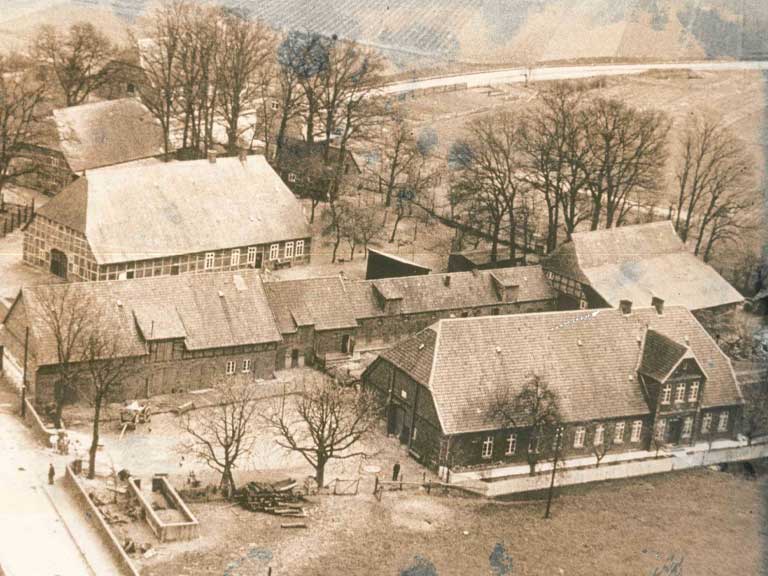
The first historical mentions of the village date back to the 11th century.
In the time of the Frankish Emperor Charles, the Saxon nobleman Reynestorpe had a noble estate built. He gave the village its name.
The church in Reinstorf was first mentioned in 1059 AD. It is named Vitus Church after the martyr Vitus. According to legend, he was a monk who performed miraculous deeds.
In 1450, the village of Reinstorf had five plow yards and four half-plow yards. The Diercksen family’s farmstead, where the hotel is located, dates back to the late Wilhelminian period. The high quality of the farmhouse is a sign of a farm that was once well run.
Reinstorf has existed for almost 900 years, as the village and church were mentioned in a document from Pope Calixt II confirming the ownership of the Rastede monastery in Oldenburg as early as September 27, 1124. Until the 1960s, the village, with its church and school, a doctor, three inns and numerous craft businesses, was the central location for the surrounding villages, which all belong to the parish of Reinstorf.
The village has changed over the last 20 years. Some farms have gone out of business. The school, two of the three village pubs, the stores, the savings bank and the post office no longer exist. What remains are the social centers of the village: St. Vitus Church (dedicated to the emergency helper St. Vitus) including the rectory and the St. Vitus generation house of the Verein für Heimatpflege e. V., the Hubertus-Reinstorf and Surroundings Shooting Club with the large
clubhouse and the shooting range, the volunteer fire department and the sports club. The
Wirtschaftskreis Reinstorf e. V. (Reinstorf Business Association) strives to revitalize the economy through advertising and events in addition to the remaining craft and
catering businesses. In the 1980s, the house numbering system was replaced by street names and new house numbers. In 2003, a new development area with 16 houses was built in the west of the village. In 2013, in time for the 888th anniversary celebrations, road construction work was completed as part of the village renewal, including the renewal of the sewage system in large parts of the village, so that the village has a friendly appearance and hotel guests can enjoy the village again. There are several prehistoric burial sites in the municipality. The Reinstorf megalithic tomb is located south of the B 216. The Holzen megalithic tomb is located approx. 500 m north of the village of Holzen near the Verkittete Sande, see list of natural monuments in the district of Lüneburg. The hunebeds near Horndorf are located north of the village of Horndorf, approx. 1000 m east of Reinstorf.